 Posted by
At the end of every school year, the words “graduation” and “commencement” show up everywhere — on invitations, school calendars, and social media posts. Most people use them interchangeably, and in everyday conversation, that’s fine. But when it comes to commencement vs graduation, the two terms technically describe different things.
The short version: graduation is earning your degree or diploma, and commencement is the ceremony that celebrates it. This guide breaks down what each word means, when graduation officially happens, what to expect at a commencement ceremony, and why the difference matters for invitations, records, and planning.

What Does Graduation Mean?
Graduation means completing the requirements of an academic program and receiving the degree or diploma that goes with it. Merriam-Webster defines graduation as “the award or acceptance of an academic degree or diploma.”
In other words, graduation is an academic milestone and a status. It’s tied to:
- Completing requirements: Finishing all required courses, credits, and exams for your program.
- Official approval: Your school confirming, often through a degree audit or graduation application, that every requirement has been met.
- Receiving the credential: Being awarded your high school diploma or college degree, which is recorded on your official transcript.
Your diploma is the lasting proof of that achievement. Schools looking to make that moment special can explore Graduation Authority’s Custom Diplomas & Diploma Covers.
What Does Commencement Mean?
Commencement is the formal ceremony that celebrates graduates and their achievements. Merriam-Webster defines it as “the ceremonies or the day for conferring degrees or diplomas.”
The word itself comes from “commence,” meaning “to begin.” That’s no accident. Commencement marks the end of one chapter, but it’s framed as the beginning of the next one — a career, further education, or whatever comes next. The tradition traces back to medieval European universities, where completing studies meant a scholar could begin, or commence, teaching and practicing in their field.
The Main Difference at a Glance
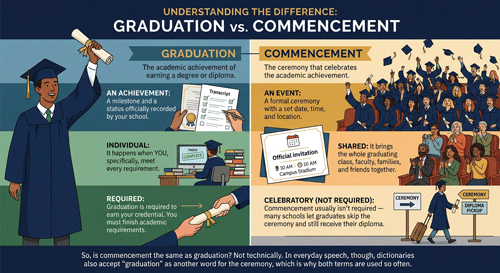
The main difference between commencement and graduation is that graduation is the academic achievement of earning a degree or diploma, while commencement is the ceremony that celebrates it. You graduate by finishing your requirements; you attend commencement to mark the occasion.
- Graduation is an achievement: It’s a milestone and a status that’s officially recorded by your school.
- Commencement is an event: It’s a formal ceremony with a set date, time, and location.
- Graduation is individual: It happens when you, specifically, meet every requirement.
- Commencement is shared: It brings the whole graduating class, faculty, families, and friends together.
- Graduation is required to earn your credential: Commencement usually isn’t — many schools let graduates skip the ceremony and still receive their diploma.
So, is commencement the same as graduation? Not technically. In everyday speech, though, dictionaries also accept “graduation” as another word for the ceremony, which is why both terms are used so often.
When Does Graduation Officially Happen?
Graduation officially happens when your school confirms you’ve met every requirement, not necessarily on the day you walk across the stage. Most schools follow a similar process:
- Apply to graduate: Many colleges require students to submit a graduation application, often at the start of their final term, to trigger a degree audit.
- Complete the audit: The registrar reviews credits, major and minor requirements, and GPA.
- Clear any holds: Unpaid balances or unreturned materials can delay your diploma or transcript.
- Degree conferral: Once everything checks out, the school confers the degree and records an official date.
That official conferral date can differ from the ceremony date. Final grades may still be processing on commencement day, and many colleges mail diplomas weeks after the ceremony. The date on your transcript is the one that counts for jobs, graduate school, and licensing.
What Happens at a Commencement Ceremony?
A commencement ceremony is a celebration built on long-standing traditions. While every school adds its own touches, most ceremonies include:
- The processional: Graduates and faculty enter in caps and gowns, traditionally to “Pomp and Circumstance.”
- Welcome and speeches: Remarks from school leaders, student speakers, and often a keynote or guest speaker.
- Presentation of diplomas or degrees: Graduates’ names are read as they cross the stage.
- Turning of the tassels: Graduates move their tassels together to mark the transition from candidate to graduate.
- The recessional: Graduates exit together to celebrate with family and friends.
Ceremony traditions vary by school and degree level. For a detailed sample order of events, see Graduation Authority’s Guide to Creating a Graduation Program, and learn when to move your tassel in the Quick Guide to the Graduation Tassel.

Can You Attend Commencement Before You Officially Graduate?
Sometimes, yes. Because commencement is a celebration rather than the official awarding of your degree, some schools allow students to walk in the ceremony while a few final requirements are still pending — for example, a summer course or a final internship.
Policies vary widely, though. Some schools only allow students who have completed every requirement to participate, while others set a limit on how many credits can be outstanding. Check your school’s eligibility rules with your advisor or registrar well before the ceremony registration deadline.
How Do Schools and People Actually Use These Terms?
In practice, schools tend to use each word in specific phrases:
- “Graduation requirements” and “graduation application” refer to the academic side — what you need to complete to earn your degree.
- “Commencement ceremony” and “commencement speaker” refer to the event itself.
- “Graduation party” and “graduation gift” are everyday phrases that celebrate the achievement.
Many high schools simply call the ceremony “graduation,” while colleges more often use “commencement.” Both are widely understood, and everyday usage regularly blurs the line.
Why Does the Difference Between Commencement and Graduation Matter?
Knowing the difference between commencement and graduation helps in a few practical ways:
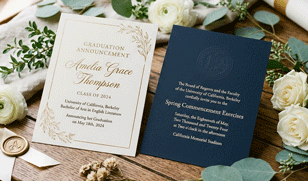
- Invitations and announcements: You announce your graduation, but you invite people to your commencement ceremony.
- Schedules: The ceremony date and the official degree conferral date may not match, which matters for job start dates and graduate school enrollment.
- Official records: Employers and schools verify your graduation date, not the date you walked.
- Ceremony planning: Commencement involves its own checklist, from caps and gowns to tickets and travel.
Quick tip: when in doubt, check your school’s communications to see how it uses each term. And when it’s time to prepare for the ceremony itself, browse Graduation Authority’s Graduation Caps and Gowns to get ready for the big day.
FAQ
Is commencement the same as graduation?
Not technically. Graduation is the academic achievement of completing your program and earning a degree or diploma, while commencement is the ceremony that celebrates it. In everyday speech, though, people often use the words interchangeably, and dictionaries accept “graduation” as another word for the ceremony. When it matters, such as on official records, graduation refers to earning the degree itself.
What is the difference between a commencement ceremony and a graduation ceremony?
In most cases, there’s no real difference — both terms describe the same event. A commencement ceremony is the formal celebration where graduates walk, hear speeches, and are presented with diplomas or degrees. Colleges more often call it commencement, while many high schools call it graduation. Either way, the ceremony celebrates graduation rather than officially awarding the degree.
Do you officially graduate at commencement?
Usually not. You officially graduate when your school confirms you’ve completed every requirement and confers your degree, which is recorded on your transcript with an official date. That date may come before or after commencement, since final grades are often still processing on ceremony day. Many colleges mail diplomas weeks after the commencement ceremony.
Two Words, One Celebration
Graduation and commencement are closely related, but they describe two different ideas. Graduation marks the academic achievement of completing your program and earning your degree or diploma. Commencement is the ceremony that celebrates that achievement with classmates, faculty, family, and friends. Both recognize years of hard work — and both deserve to be celebrated.
Planning a commencement ceremony? Visit Graduation Authority’s Graduation Planning page to coordinate caps, gowns, and accessories for your entire class.