
 Posted by
Graduation day is a whirlwind of excitement, from the thrill of walking across the stage to celebrating with family and friends. Amid all the pomp and circumstance, one small detail tends to cause the most questions: the graduation tassel. Which side does it go on? When do you move it? And what does it actually mean?
This guide answers what a graduation tassel is, what tassels mean at graduation, how to put a tassel on a graduation cap, and exactly when and which way to move it, so you can focus on enjoying your big moment instead of second-guessing your cap.
What Is a Graduation Tassel?
A graduation tassel is the bundle of colored threads that hangs from the button at the center of a graduation cap. It’s attached by a loop at the top and is worn hanging over one side of the cap, where it’s moved during the ceremony to mark the moment a candidate officially becomes a graduate.
Most graduation tassels have a few simple parts:
- Loop: The cord at the top that slips over the cap’s button to hold the tassel in place.
- Head: The wrapped or knotted section just below the loop that gathers the threads together.
- Strands: The long threads that hang down from the head, in one, two, or three colors.
- Year charm (tassel drop): An optional metal charm showing the graduation year, usually in gold or silver.
Tassels became part of academic dress as caps and gowns developed in European universities and were later standardized in the U.S. by the Intercollegiate Code of Academic Costume in the 1890s. That code, now maintained by the American Council on Education, still calls for tassels to be black or the color of the graduate’s field of study, with gold permitted on doctoral caps.
What Is a Graduation Tassel Drop?

A graduation tassel drop, also called a date drop or year charm, is the small metal charm that hangs from the tassel and displays the graduation year. It’s usually attached where the strands meet the head of the tassel, so the year sits near the top and stays visible.
Tassel drops are most common at high school graduations, where the year is a big part of the celebration, but many college graduates choose them too. Because they turn the tassel into a dated keepsake, year charms are one of the main reasons graduates hold onto their tassels long after the ceremony.
Graduation Authority’s Adult Graduation Tassel With Year Charm includes a year charm, and specialty options like the Silver Bling Year Charm Tassel add extra sparkle for graduates who want their tassel to stand out.
How Do You Put a Tassel on a Graduation Cap?
Attaching your tassel takes less than a minute, but it’s worth doing before the ceremony so you’re not rushing in line.
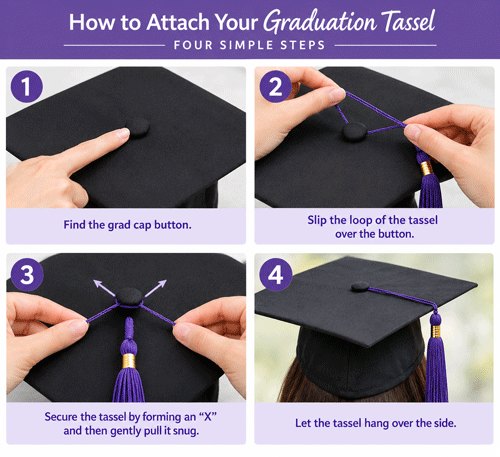
Once your tassel is attached, make sure the cap itself sits correctly. See Graduation Authority’s guide on How to Wear a Graduation Cap for step-by-step placement tips.
Which Way Does the Tassel Go Before You Graduate?
Before you graduate, the tassel goes on the right side of the cap for high school and bachelor’s graduates. After degrees or diplomas are conferred, graduates move the tassel from right to left together.
Here’s how tassel placement typically works by degree level:
- High school and bachelor’s degrees: The tassel starts on the right side. When the presiding official announces it, usually after the class has been presented or degrees have been conferred, everyone moves their tassel to the left side at the same time.
- Master’s and doctoral degrees: The tassel traditionally starts on the left side and stays there for the entire ceremony, signifying that the graduate has already earned a degree. Many graduate programs mark the milestone with hooding instead.
This moment, often called “turning the tassel,” is one of the most photographed parts of the ceremony. It symbolizes the transition from candidate to graduate. Practices vary, though, and some schools reverse the order or have graduates move the tassel as they cross the stage, so always follow your school’s instructions.

What Do Tassels Mean at Graduation?
Beyond marking the transition to graduate, the tassel’s color often carries meaning of its own:
- School colors: Most high schools use tassels in one or two school colors, which creates a unified look across the class and shows school spirit.
- Field of study: At the college level, tassels may match the academic color of the graduate’s field, such as light blue for education or golden yellow for science, following the academic costume code.
- Black or gold: Many colleges use plain black tassels for every graduate, and doctoral graduates often wear gold tassels on their tams.
- Honors: Some schools give honor graduates a different tassel, such as gold or a multicolor design, to recognize academic achievement.
For a deeper look at what academic colors represent across the whole outfit, read Graduation Authority’s Complete Guide to Cap and Gown Colors.

How to Choose the Right Tassel
If your school doesn’t supply tassels, or you’re a coordinator ordering for the whole class, keep these tips in mind:
- Match the gown and school colors. Choose tassel colors that complement the gown color and use your school’s official shades so every graduate matches.
- Pick the right size. Choose adult-size tassels for high school and college caps and shorter child-size tassels for preschool and kindergarten graduates so they fit smaller caps.
- Decide on a year charm. Choose gold or silver to coordinate with the tassel colors and any other accessories.
- Consider customization. Two- and three-color tassels let schools combine colors, and specialty charms add a personal touch.
Browse Graduation Authority’s Graduation Tassels to find single-, two-, and three-color tassels for every age and school color.
Tassel Traditions Around the World
Turning the tassel is most closely associated with graduation ceremonies in the United States. In many other countries, including the United Kingdom and much of the Commonwealth, each university sets its own academic dress rules, and graduates may wear different styles of caps — or none at all — during the ceremony.
Wherever the ceremony takes place, the shared idea is the same: a simple visual moment that marks the shift from student to graduate. Many families also adopt their own traditions, such as passing a tassel down to a younger sibling or displaying tassels from each graduation in the family together.
Caring for Your Graduation Tassel
Keep your tassel in its packaging until graduation day to prevent tangles. If the strands get bent, smooth them with your fingers or a wide-tooth comb, or hold the tassel near the steam from a kettle or handheld steamer for a few seconds to relax the threads.

After the ceremony, your tassel makes a meaningful keepsake. Popular ideas include:
- Displaying it in a shadow box with your diploma, cap, and photos.
- Hanging it from a diploma frame or a photo display at home.
- Adding it to a scrapbook or memory box with your graduation program.
Avoid hanging your tassel from a car’s rearview mirror, since anything hanging there can block your view of the road.
Tassel Alternatives and Trends
The classic tassel isn’t going anywhere, but graduates are finding new ways to personalize it:

- Specialty charms: Rhinestone, bling, and black-tone year charms add style to a standard tassel.
- Multicolor designs: Three-color tassels combine school colors with an extra accent color.
- Decorated caps: Where schools allow it, decorated caps put the tassel at the center of a personalized design.
- Keepsake displays: Framing and shadow box displays make the tassel part of a lasting home decor piece.
Sharing Your Graduation Experience
You’ll want plenty of photos of your big day. For selfies, group shots, and formal portraits, keep the tassel hanging on the side away from the camera so it doesn’t block your face. A close-up shot of the tassel and year charm, or a short video of the class turning their tassels together, makes great social media content.
Caption ideas like “Tassel was worth the hassle” or a simple “Class of [Year]” with your school name are easy ways to celebrate the moment and share it with everyone who helped you get there.
FAQ
Which way does the tassel go before you graduate?
Before you graduate, the tassel goes on the right side of the cap for high school and bachelor’s degree graduates. It stays there until the presiding official tells the class to move it, usually after diplomas or degrees are conferred. Master’s and doctoral graduates traditionally wear the tassel on the left throughout the ceremony. Always follow your school’s instructions, since some traditions differ.
Which way do you move your tassel when you graduate?
When you graduate, you move your tassel from the right side of the cap to the left side. For high school and bachelor’s graduates, this happens all at once when the presiding official announces it, symbolizing the transition from candidate to graduate. Master’s and doctoral graduates usually start with the tassel on the left and don’t move it at all.
What is a graduation tassel drop?
A graduation tassel drop, also called a date drop or year charm, is the small metal charm attached to a tassel that displays the graduation year. It usually hangs near the top of the tassel where the strands are gathered, and it typically comes in gold or silver. Tassel drops turn a tassel into a dated keepsake that graduates can display long after the ceremony.
Small Detail, Big Meaning
The graduation tassel may be one of the smallest pieces of your regalia, but it carries some of the biggest meaning. From attaching it correctly to knowing exactly when to move it from right to left, a little preparation helps you look your best and fully enjoy the moment. Congratulations, graduate — now go celebrate everything you’ve achieved.
Ready for the big day? Shop Graduation Authority’s Graduation Tassels to find a tassel and year charm in your school colors.