 Posted by
 A graduation ceremony marks a major milestone, celebrating students’ hard work, perseverance, and achievements. The graduation ceremony program is a big part of that day. It guides guests through the event, keeps the ceremony running smoothly behind the scenes, and becomes a keepsake that graduates and families hold onto for years.
Creating a program for graduation takes more planning than it might seem, from the order of events to the final print run. This guide covers everything a graduation coordinator or committee needs to know, including graduation program format options, a sample graduation ceremony program, design tips, and how to print and distribute copies.
Understanding the Purpose of a Graduation Program
A graduation program does two jobs at once. It’s an organizational tool for the people running the ceremony and an informational guide and memento for everyone attending. That’s why many schools plan two versions:
- Master Program: The behind-the-scenes blueprint for the ceremony. It includes every detail, from speeches and musical performances to timing cues, speaker order, and stage directions, so the committee can manage the event seamlessly. The Master Program is for staff, speakers, and volunteers only.
- Keepsake Program: The printed, folded version handed to graduates and guests. It focuses on the order of events, the names of graduates, and recognition of honors, and many schools keep it to around four to eight pages, including the front and back covers.
Graduation coordinators and committees are typically responsible for designing, approving, printing, and distributing both. Clarity matters most — guests should be able to glance at the program and know exactly where they are in the ceremony.
Need help organizing every part of the ceremony? Graduation Authority’s Graduation Planning resources make it easy to coordinate caps, gowns, and accessories for your entire class.
What Graduation Program Format Should You Choose?
The right graduation program format depends on your class size, budget, and how much content you want to include.
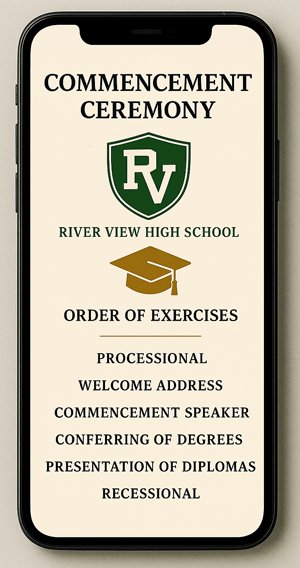
- Single sheet: A one-page, front-and-back program. It’s affordable and quick to produce, but it has limited room for long graduate lists or extras.
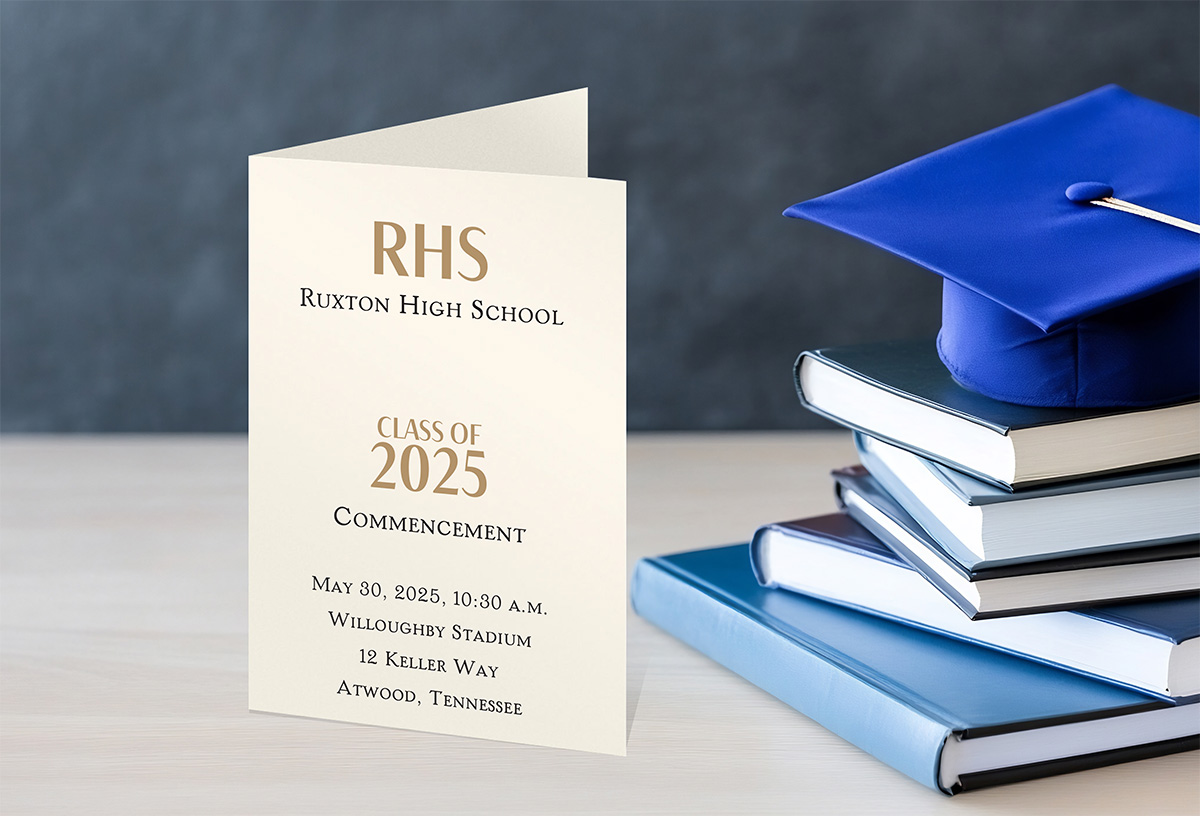
- Trifold or bifold: A folded program with space for the order of events, graduate names, and acknowledgments. It’s a popular middle ground for many high schools.
- Booklet: A multi-page, stapled program with room for photos, messages, honors, and ads. It makes the best keepsake but costs more and takes longer to design and print.
- Digital program: A web page or PDF shared by link or QR code. It’s low-cost and easy to update, but some guests prefer a printed copy, and it isn’t much of a keepsake. Many schools pair a digital version with a smaller print run.
What Is a Sample Graduation Ceremony Program Order of Events?
Every school adapts the program of a graduation ceremony to its own traditions, but most follow a similar flow. Here’s an example of a graduation program order of events you can use as a starting point:
- Prelude music: Music plays as guests are seated.
- Processional: Graduates enter, traditionally to “Pomp and Circumstance.”
- National anthem or pledge: Often led by a student, choir, or band.
- Welcome: Opening remarks from the principal, superintendent, or college president.
- Student speeches: Remarks from the salutatorian, class president, or other student leaders.
- Musical performance: A selection from the choir, band, or a student soloist.
- Keynote or guest speaker: A commencement address from an invited speaker.
- Valedictorian address: A final student speech before diplomas are awarded.
- Presentation of the class: An administrator formally presents the graduating class.
- Conferring of diplomas or degrees: Each graduate’s name is read as they cross the stage.
- Turning of the tassels: Graduates move their tassels together to mark the official transition.
- Closing remarks: Final words and congratulations.
- Recessional: Graduates exit as music plays.
College ceremonies often follow a similar order but may add an academic procession of faculty, the conferring of degrees by college or school, and a hooding ceremony for graduate degrees.
Designing the Cover
The cover is the first thing guests see and the part graduates are most likely to keep, so make it count.
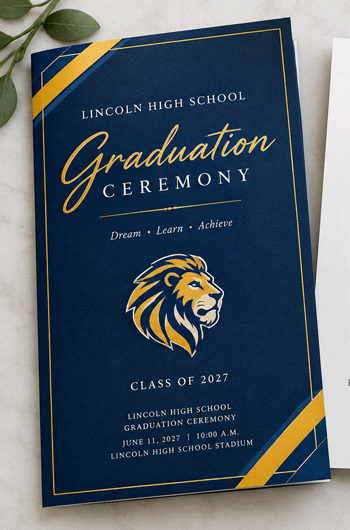
- Lead with the essentials: Include the school name, a title such as “Celebrating the Graduation of the Class of [Year],” and the ceremony date, time, and location.
- Use school branding: Feature school colors, the school logo or crest, and the mascot to create a polished, spirited look.
- Keep it clean: A simple layout with plenty of white space looks more elegant than a crowded design.
- Get students involved: Ask the art club or a marketing class to design the cover or contribute artwork.
How Should You Organize the Content of a Graduation Program?
A well-organized graduation ceremony program makes it easy for guests to follow along. Key sections to include are:
- Title page: The cover details listed above.
- Order of events: The ceremony schedule, with the name and title of each speaker and performer.
- Welcome message: A short note from the principal, president, or graduation committee.
- List of graduates: Every graduate’s name, organized alphabetically or by school or degree.
- Honors and awards: Recognition for honor graduates, scholarships, and special distinctions.
- Acknowledgments: Thanks to faculty, staff, families, and volunteers.
- Personal notes, ads, and tributes: Optional messages from families and sponsors.
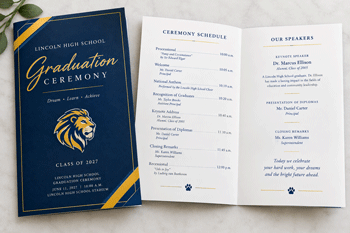
Structure the program so it reads in the same order as the ceremony, and use clear headings and consistent fonts so guests can find what they need at a glance.
Highlighting Graduates in the Program
Graduates are the heart of the ceremony, so the program should celebrate them. Beyond the full list of names, consider:
- Marking honor graduates with symbols, such as an asterisk for honor roll or a star for National Honor Society.
- Listing the valedictorian, salutatorian, and class officers on their own page.
- Including senior photos, short bios, or post-graduation plans in a booklet format.
- Adding a class quote or class motto chosen by the students.
Personal recognition makes the program a keepsake worth saving. Many schools also present medallions to top students during the ceremony; see Graduation Authority’s Graduation Medals & Awards for valedictorian, salutatorian, and honors medallions.
Incorporating Special Features Into Your Graduation Program
Special features make the program — and the ceremony — more memorable.
Advertising and fundraising: Sell space on the back pages to parents and local businesses. Families can share baby photos or well-wishes, businesses can promote their services, and the revenue can offset printing costs.
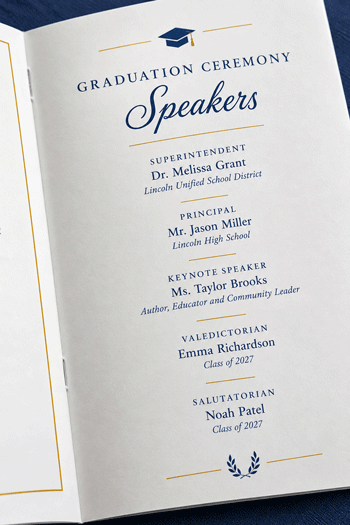
Speakers: For high school graduation, it’s a good idea to limit speakers to around five and keep most speeches to about seven minutes, with the keynote address running a bit longer. Typical speakers include the superintendent, principal, keynote or guest speaker, valedictorian, and salutatorian. College ceremonies often feature fewer speakers.
Music: Performances bridge transitions and set the mood. Traditional pieces like “Pomp and Circumstance” resonate with every audience, while modern songs like “Best Day of My Life” by American Authors or “My Future” by Billie Eilish can add emotion and connection.
Quotes and messages: Add an inspirational quote, a message from faculty, or a note from the class sponsor.
Proofreading and Finalizing the Program
Mistakes in a graduation program are hard to fix once it’s printed — and a misspelled name is something a family will remember. Build in time to review carefully:
- Check every graduate’s name against official school records, and ask students to confirm how their names should appear.
- Confirm the spelling and titles of all speakers, performers, faculty, and guests.
- Verify the date, time, location, and order of events with the ceremony planners.
- Have at least two people outside the design team proofread the final draft before approval.
Add proofing deadlines to your planning calendar. Graduation Authority’s Ultimate Graduation Timeline e-book and Graduation Checklist for a Stress-Free Ceremony can help you map out every deadline leading up to the big day.
How Many Graduation Programs Should You Print, and How Should You Distribute Them?
Once the design is approved, it’s time to print. Choose a heavier paper stock for keepsake programs so they hold up, and request a printed proof before the full run to check colors and alignment. Leave a few weeks of lead time so there’s room for corrections.
To estimate how many programs to print, start with the number of graduates plus the number of guest tickets each graduate receives, then add extras for faculty, staff, speakers, and walk-in guests. If guest seating isn’t ticketed, base your count on the venue’s capacity.
On ceremony day, distribute programs strategically:
- Place a program on each graduate’s seat.
- Have ushers hand programs to guests as they enter.
- Set up an information table at the entrance with extra copies.
Diplomas are the other keepsake graduates take home. Explore Graduation Authority’s Custom Diplomas & Diploma Covers to complete your ceremony.
FAQ
What should be included in a graduation ceremony program?
A graduation ceremony program should include the school name, ceremony date, time, and location, the order of events, the names and titles of speakers and performers, and a complete list of graduates. Many programs also include a welcome message, honors and awards, acknowledgments for faculty and families, and optional ads or tributes. Organize everything in the same order as the ceremony so guests can follow along easily.
What is the order of a graduation ceremony program?
Most graduation ceremonies follow a similar order: prelude music, the processional, the national anthem or pledge, a welcome, student speeches, a musical performance, the keynote address, the valedictorian address, the presentation of the class, the conferring of diplomas, the turning of the tassels, closing remarks, and the recessional. Schools adjust this sample program to fit their own traditions.
How many graduation programs should you print?
Start with the number of graduates, add the number of guest tickets each graduate receives, and then add extras for faculty, staff, speakers, and walk-in guests. If seating isn’t ticketed, base the count on the venue’s capacity. Printing a small surplus is better than running out, since programs also become keepsakes that families want to take home.
Celebrate the Milestone With a Program Worth Keeping
Graduation is a momentous occasion filled with joy, nostalgia, and a sense of accomplishment. A well-planned graduation ceremony program — supported by a detailed Master Program behind the scenes and a polished Keepsake Program in guests’ hands — helps the day run smoothly and gives everyone a memento to treasure. With careful planning, clear organization, and thorough proofreading, your graduates will be celebrated and remembered long after the ceremony ends.
Start planning your ceremony with Graduation Authority’s Graduation Planning resources to coordinate caps, gowns, and accessories for your entire class.